AI Customer Support: How Agentic AI Is Replacing Traditional Chatbots in 2026
Build Your Website in Minutes with One-Click Import – No Coding Hassle!
agentic ai crm
AI Customer Support: The 2026 Shift from Chatbots to Autonomous Resolution
Introduction
AI Customer Support is undergoing its biggest transformation since the introduction of chatbots more than a decade ago. While traditional chatbots helped organizations automate simple FAQs and route customer inquiries, they often struggled when conversations became more complex. Customers frequently found themselves repeating information, waiting for human intervention, or navigating frustrating support experiences.
The rise of agentic AI is changing that reality.
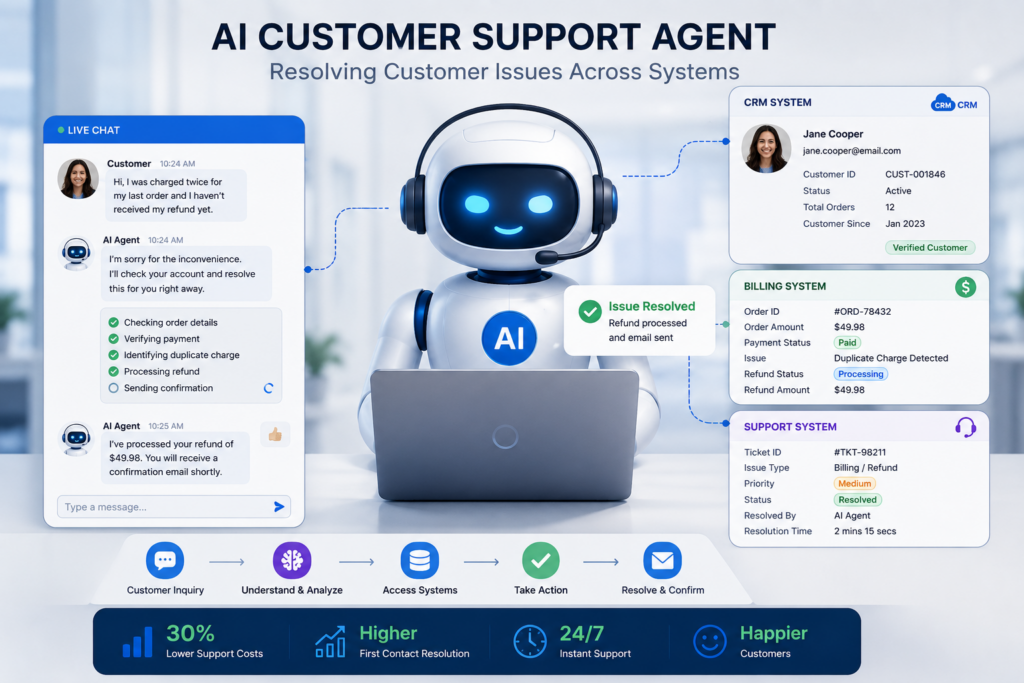
Unlike traditional chatbots that simply respond to prompts, modern AI agents can understand customer intent, access multiple business systems, make decisions, and complete actions autonomously. Instead of telling customers how to solve a problem, AI agents can solve the problem themselves.
Industry forecasts suggest that this transformation is accelerating rapidly. Cisco projects that by 2026, more than half of customer interactions will involve agentic AI, while Gartner predicts that by 2029, autonomous systems could resolve up to 80% of common customer service issues without human intervention.
For businesses, the impact is measurable. Organizations are already reporting lower support costs, improved first-contact resolution rates, shorter response times, and higher customer satisfaction scores.
As customer expectations continue to rise, AI customer support is becoming a strategic advantage rather than simply an operational tool.
Quick Summary
| Category | Insight |
| Technology Trend | Agentic AI |
| Primary Benefit | Autonomous Resolution |
| Cost Reduction Potential | Up to 30% |
| Key Outcome | Higher First Contact Resolution |
| Industry Adoption | Growing Rapidly |
| Future Outlook | AI Agents Become First-Line Support |
Table of Contents
- What Is AI Customer Support?
- Why Traditional Chatbots Are Reaching Their Limits
- What Makes Agentic AI Different?
- How Autonomous Resolution Works
- Real-World Customer Support Workflow
- Business Benefits of AI Customer Support
- Impact on Customer Experience
- Cost Savings and ROI
- Challenges and Risks
- Future of Customer Support
- FAQs
- Final Verdict
What Is AI Customer Support?
AI Customer Support refers to the use of artificial intelligence technologies to assist, automate, and improve customer service operations.
Historically, AI customer support focused on:
- Frequently asked questions
- Ticket routing
- Basic chatbot interactions
- Knowledge base searches
Modern AI customer support is significantly more advanced.
Today’s AI agents can:
- Access CRM systems
- Verify customer accounts
- Retrieve order information
- Update records
- Process refunds
- Escalate cases
- Resolve issues autonomously
The result is a shift from conversational support to action-oriented support.
Why Traditional Chatbots Are Reaching Their Limits
Many businesses adopted chatbots expecting dramatic improvements in efficiency.
Unfortunately, traditional chatbots often struggled with:
Limited Understanding
Most chatbots relied on predefined intents and keywords.
Example:
Customer:
“My order hasn’t arrived.”
Bot:
“Would you like shipping information?”
While technically correct, the bot often lacked context and could not investigate the issue.
No Access to Systems
Many legacy chatbots could not:
- Check inventory
- Access CRM records
- Process refunds
- Update accounts
They could only provide information.
Frequent Escalations
Complex requests often required:
- Human intervention
- Ticket creation
- Multiple transfers
This reduced customer satisfaction.
What Makes Agentic AI Different?
Agentic AI changes customer support by enabling systems to take action.
Traditional chatbot:
Question → Response
Agentic AI:
Question
↓
Understand Intent
↓
Access Systems
↓
Make Decisions
↓
Execute Actions
↓
Confirm Resolution
Instead of simply answering questions, AI agents complete tasks.
How Autonomous Resolution Works
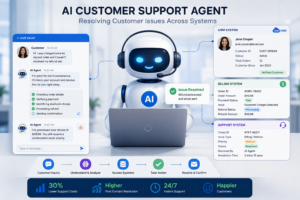
Modern AI customer support systems operate across multiple business applications.
Systems Accessed
- CRM Platforms
- ERP Systems
- Order Management Systems
- Billing Platforms
- Customer Databases
- Knowledge Bases
Example Workflow
Customer:
“I received the wrong item.”
AI Agent:
- Verifies customer identity.
- Retrieves order details.
- Reviews shipment information.
- Confirms mismatch.
- Creates replacement order.
- Generates return label.
- Sends confirmation email.
No human involvement required.
This is autonomous resolution.
Real-World Example: Subscription Billing Issue
Traditional Process:
- Customer contacts support.
- Agent reviews account.
- Agent checks payment records.
- Agent contacts billing team.
- Customer waits.
Resolution time: Several hours or days.
Agentic AI Process:
- Customer reports issue.
- AI agent accesses billing system.
- Reviews payment records.
- Identifies failed transaction.
- Updates subscription.
- Sends confirmation.
Resolution time: Minutes.
Business Benefits of AI Customer Support
Faster Resolution Times
Customers receive answers immediately.
Higher First Contact Resolution
Issues are resolved during the first interaction.
Reduced Operational Costs
Fewer support agents are needed for repetitive requests.
24/7 Availability
AI customer support operates continuously.
Improved Scalability
Support capacity expands without proportional staffing increases.
How AI Customer Support Improves Customer Experience
Customer expectations continue to increase.
Customers want:
- Immediate responses
- Personalized interactions
- Accurate information
- Fast resolutions
Agentic AI supports these expectations by:
- Eliminating wait times
- Reducing transfers
- Providing consistent service
- Completing tasks directly
Cost Savings and ROI
One of the strongest business cases for AI customer support is cost reduction.
Organizations often spend millions annually on:
- Contact centers
- Support agents
- Ticket management
- Escalation handling
Agentic AI helps reduce costs by:
Lower Ticket Volumes
Many issues are resolved automatically.
Reduced Handling Time
Support interactions become shorter.
Fewer Escalations
AI agents manage more complex cases.
Better Resource Allocation
Human agents focus on high-value situations.
Many organizations report support cost reductions approaching 30% while maintaining or improving customer satisfaction.
Key Metrics Improved by AI Customer Support
| Metric | Traditional Support | Agentic AI Support |
| Response Time | Minutes to Hours | Seconds |
| First Contact Resolution | Moderate | High |
| Escalation Rate | High | Lower |
| Cost Per Ticket | Higher | Lower |
| Customer Satisfaction | Variable | Improved |
| Availability | Business Hours | 24/7 |
Challenges and Risks
Security
AI agents require access to sensitive customer data.
Governance
Businesses need clear rules regarding autonomous decisions.
Compliance
Industries such as healthcare and finance require additional controls.
Customer Trust
Some customers still prefer human interactions for complex issues.
Exception Handling
Not every scenario can be fully automated.
Human oversight remains important.
The Future of AI Customer Support
The future of customer service will likely involve collaboration between humans and AI agents.
Expected evolution:
2026
AI agents assist support teams.
2027
Autonomous resolution expands across common support requests.
2028
AI becomes the primary support channel for many organizations.
2029
Autonomous systems resolve the majority of routine customer issues.
Human agents focus on:
- Escalations
- Strategic accounts
- Complex negotiations
- Emotional situations
AI handles operational support at scale.
Best Use Cases for AI Customer Support
Ideal For
- E-commerce
- SaaS Companies
- Telecommunications
- Banking
- Insurance
- Subscription Businesses
- Travel Services
Less Suitable For
- Highly regulated approvals
- Legal disputes
- Sensitive medical consultations
- Complex enterprise negotiations
Frequently Asked Questions
What is AI customer support?
AI customer support uses artificial intelligence to automate and improve customer service interactions and issue resolution.
How is agentic AI different from traditional chatbots?
Traditional chatbots primarily answer questions. Agentic AI can access systems, make decisions, and complete actions autonomously.
Can AI customer support reduce costs?
Yes. Many organizations report significant reductions in support costs due to automation and reduced ticket handling requirements.
What is autonomous resolution?
Autonomous resolution occurs when an AI agent identifies, investigates, and resolves a customer issue without requiring human intervention.
Will AI replace customer service agents?
AI will automate many routine interactions, but human agents will remain essential for complex, sensitive, and high-value customer situations.
Is AI customer support secure?
When implemented properly with governance and access controls, AI customer support can be highly secure.
Final Verdict
AI Customer Support is rapidly evolving from simple chatbot interactions to autonomous issue resolution powered by agentic AI. Unlike traditional chatbots that primarily answer questions, AI agents can investigate issues, access business systems, make decisions, and execute actions on behalf of customers.
For organizations seeking improved efficiency, higher customer satisfaction, and lower operational costs, AI customer support offers one of the clearest and most measurable business cases for enterprise AI adoption. As technology continues to mature, autonomous resolution is expected to become the standard operating model for customer service across industries.