Agentic AI in SaaS: How AI Agents Are Automating Workflows Across System
Build Your Website in Minutes with One-Click Import – No Coding Hassle!
Agentic-AI-in-SaaS
Agentic AI in SaaS: The Future of Workflow Automation Across Systems
Introduction
For decades, businesses have invested billions of dollars in software platforms designed to improve productivity and streamline operations. From ERP systems and CRMs to accounting software, project management tools, and collaboration platforms, organization’s today rely on dozens—sometimes hundreds—of software applications to run their operations.
Yet despite this digital transformation, a surprising amount of work remains manual.
Employees still spend hours copying data between systems, reconciling spreadsheets with ERP records, reviewing emails, updating customer records, generating reports, and coordinating workflows across disconnected platforms. In many organization’s, the real bottleneck isn’t the software itself—it’s the human effort required to make different software systems work together.
This is where Agentic AI in SaaS enters the picture.
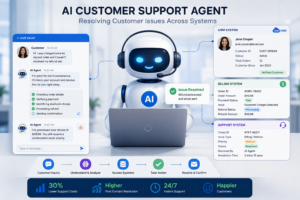
Unlike traditional automation tools that follow predefined rules, agentic AI systems can understand goals, make decisions, interact with multiple software platforms, and execute complex tasks autonomously. Rather than replacing SaaS applications, agentic AI is emerging as the intelligent layer that connects them.
Industry analysts estimate that the market opportunity for automating cross-system workflows and knowledge work could exceed $100 billion annually in the United States alone. As enterprises seek higher productivity and lower operational costs, agentic AI is rapidly becoming one of the most important trends shaping the future of software.
In this article, we’ll explore how agentic AI works, why it complements rather than replaces SaaS, and how organizations are already using AI agents to automate workflows across ERP systems, spreadsheets, email platforms, CRMs, and other business applications.
Quick Summary
| Category | Recommendation |
| Biggest Opportunity | Cross-System Workflow Automation |
| Most Impacted Teams | Finance, Operations, Procurement, Customer Service |
| Key Benefit | Reduced Manual Work |
| Primary Technology | Agentic AI & Autonomous Agents |
| Market Potential | $100 Billion+ Opportunity |
| Future Outlook | AI Layer Above Existing SaaS Stack |
What is Agentic AI?
Agentic AI refers to AI systems capable of acting autonomously toward a goal rather than simply responding to prompts.
Traditional AI answers questions.
Agentic AI completes work.
For example:
Traditional AI: “Summarize these invoices.”
Agentic AI: “Retrieve invoices from email, compare them against purchase orders in ERP, identify discrepancies, notify stakeholders, and update the accounting system.”
The difference is significant.
Instead of functioning as a chatbot, agentic AI acts as a digital worker capable of:
- Planning tasks
- Accessing multiple systems
- Making decisions
- Taking actions
- Learning from outcomes
- Escalating exceptions
Why SaaS Still Requires Human Intervention
Businesses have spent years implementing software platforms to digitize operations.
Common enterprise systems include:
| Function | Software Examples |
| ERP | SAP, Oracle, Microsoft Dynamics |
| CRM | Salesforce, HubSpot |
| Finance | NetSuite, QuickBooks |
| HR | Workday, BambooHR |
| Collaboration | Microsoft 365, Slack |
| Analytics | Power BI, Tableau |
Despite these investments, employees continue performing tasks that software cannot complete independently.
Examples include:
- Updating records across multiple systems
- Reconciling spreadsheets
- Reviewing supplier communications
- Processing customer requests
- Validating transactions
- Generating reports
These tasks consume thousands of hours annually.
The Hidden Cost of Connecting Systems
The biggest challenge isn’t a lack of software.
It’s the gaps between software.
Consider a procurement workflow:
- Supplier sends invoice via email.
- Employee downloads attachment.
- Employee checks ERP purchase order.
- Employee compares values in spreadsheet.
- Employee requests approvals.
- Employee updates finance system.
- Employee archives records.
Every step involves manual effort.
Multiply this across thousands of transactions and the cost becomes enormous.
This is why many analysts believe the next major productivity wave won’t come from new SaaS products but from automating interactions between existing systems.
How Agentic AI Works
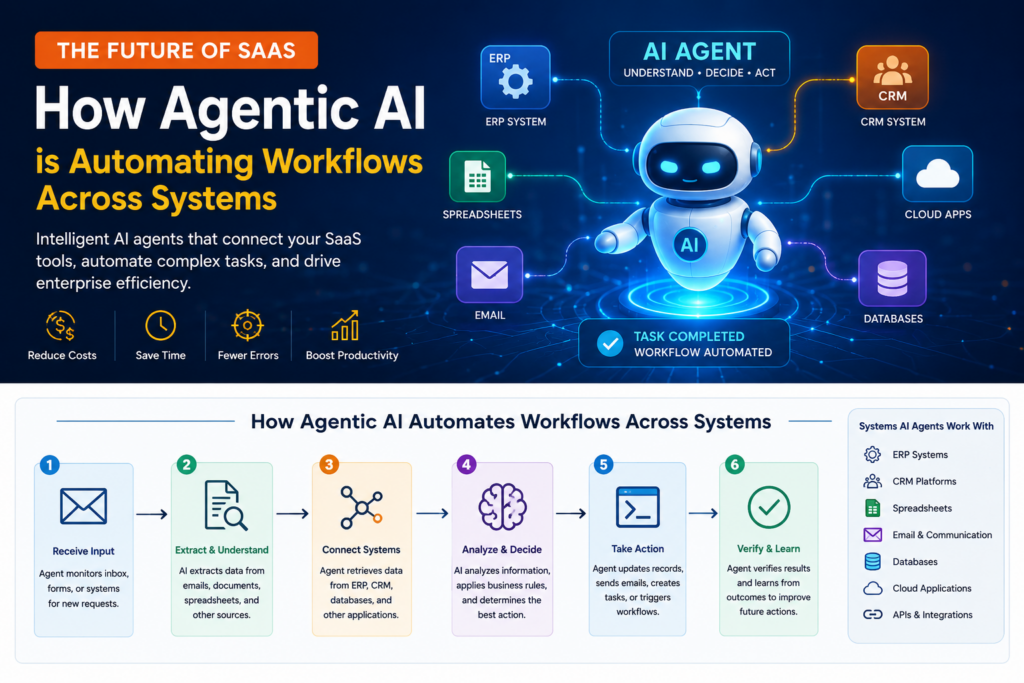
Agentic AI acts as an orchestration layer above enterprise software.
Instead of replacing systems, it interacts with them.
Core Components
Perception
The agent gathers information from:
- Emails
- Documents
- Databases
- ERP systems
- APIs
- CRM platforms
Reasoning
The agent analyzes:
- Business rules
- Historical patterns
- Context
- Exceptions
Action
The agent performs tasks such as:
- Updating records
- Sending emails
- Creating tickets
- Triggering approvals
- Generating reports
Learning
The system continuously improves based on outcomes and feedback.
Real-World Example: Invoice Reconciliation Without Human Intervention
Let’s examine a workflow that many finance teams perform daily.
Traditional Process
An accounts payable analyst:
- Receives invoice via email.
- Opens ERP system.
- Searches purchase order.
- Downloads supplier report.
- Compares values in Excel.
- Verifies approvals.
- Updates accounting system.
- Sends confirmation email.
Time required:
15–30 minutes per invoice.
Agentic AI Process
The AI agent:
- Monitors inbox continuously.
- Identifies incoming invoice.
- Extracts invoice data.
- Retrieves purchase order from ERP.
- Checks spreadsheet records.
- Validates quantities and pricing.
- Identifies discrepancies.
- Updates accounting software.
- Sends approval request if required.
- Archives documentation.
Human involvement: Only for exceptions.
Processing time: Under two minutes.
Agentic AI vs Traditional Automation
| Capability | Traditional RPA | Agentic AI |
| Rule Based | Yes | Yes |
| Understand Context | Limited | High |
| Interpret Emails | Limited | Yes |
| Handle Exceptions | Poor | Strong |
| Make Decisions | No | Yes |
| Learn from Outcomes | No | Yes |
| Multi-System Workflows | Moderate | Excellent |
Traditional automation works well for repetitive tasks.
Agentic AI excels when workflows involve judgment, interpretation, and multiple systems.
Business Functions Being Transformed
Finance
Use Cases:
- Invoice processing
- Reconciliation
- Expense audits
- Accounts payable
Procurement
Use Cases:
- Vendor onboarding
- Purchase approvals
- Contract reviews
Customer Service
Use Cases:
- Ticket resolution
- Account updates
- Escalation management
Supply Chain
Use Cases:
- Inventory monitoring
- Demand planning support
- Supplier coordination
Human Resources
Use Cases:
- Candidate screening
- Employee onboarding
- Compliance documentation
Benefits of Agentic AI
Reduced Labor Costs
Organizations can eliminate repetitive administrative work.
Faster Processing
Tasks completed in minutes rather than hours.
Fewer Errors
AI agents reduce manual data-entry mistakes.
Better Employee Productivity
Employees focus on strategic work rather than administrative tasks.
Improved Scalability
Operations can grow without proportional increases in headcount.
Potential Risks and Challenges
Governance
Who is responsible when an AI agent makes a mistake?
Security
Agents require access to multiple systems and sensitive data.
Compliance
Regulated industries require auditability and transparency.
Change Management
Employees must adapt to new ways of working.
Trust
Organizations need confidence that agents will make reliable decisions.
The $100 Billion Market Opportunity
Many enterprise software markets are already mature.
The next major value creation opportunity lies in reducing the cost of human coordination between systems.
Organizations spend billions annually on:
- Administrative operations
- Data reconciliation
- Workflow management
- Reporting
- Internal coordination
Agentic AI directly targets these inefficiencies.
As adoption grows, analysts expect a massive market opportunity exceeding $100 billion in the United States alone, driven by productivity gains, labor savings, and operational efficiency improvements.
The Future of SaaS
The future of SaaS isn’t replacement.
It’s augmentation.
Most organizations will continue using:
- ERP systems
- CRM platforms
- Finance software
- Collaboration tools
- Industry-specific applications
What changes is how work gets done.
Instead of employees manually connecting systems, AI agents will orchestrate workflows across them.
The emerging technology stack will look like:
Users
↓
AI Agents
↓
ERP | CRM | Finance | HR | Collaboration Tools
In this model:
- SaaS remains the system of record.
- AI becomes the system of action.
This shift could redefine enterprise productivity over the next decade.
Frequently Asked Questions
What is agentic AI?
Agentic AI refers to autonomous AI systems capable of planning, reasoning, making decisions, and executing tasks across multiple software systems.
Will agentic AI replace SaaS?
No. Agentic AI complements SaaS by automating workflows between existing applications.
How is agentic AI different from RPA?
Agentic AI can understand context, make decisions, and adapt to changing situations, while RPA typically follows fixed rules.
Which industries will benefit most?
Finance, healthcare, manufacturing, logistics, retail, and professional services are expected to see significant benefits.
Is agentic AI safe for enterprise use?
Yes, when implemented with appropriate governance, security controls, audit trails, and human oversight.
Can small businesses benefit?
Absolutely. AI agents can automate administrative tasks and improve productivity regardless of company size.
Final Verdict
Agentic AI represents one of the most important shifts in enterprise technology since the rise of cloud computing.
The future isn’t about replacing ERP systems, CRMs, or accounting software. Instead, it’s about eliminating the costly human effort required to connect these systems and execute workflows across them.
Organizations that successfully deploy AI agents will gain advantages through faster operations, lower costs, improved accuracy, and greater scalability.
As SaaS platforms continue to proliferate, the demand for intelligent agents capable of orchestrating work across systems will only grow. The winners in the next generation of enterprise software won’t simply provide data—they’ll provide action.