Telehealth Trends 2026: Why Virtual Care and Mental Health Continue to Lead Healthcare
telehealth-trends-2026
Telehealth Trends 2026: Why Virtual Care and Mental Health Continue to Lead Healthcare
Introduction
Telehealth trends 2026 show that virtual healthcare has firmly transitioned from a pandemic-driven necessity to a permanent part of modern healthcare delivery. A few years ago, many experts questioned whether patients and healthcare providers would continue using virtual consultations once in-person services returned. The latest data suggests the answer is a clear yes.
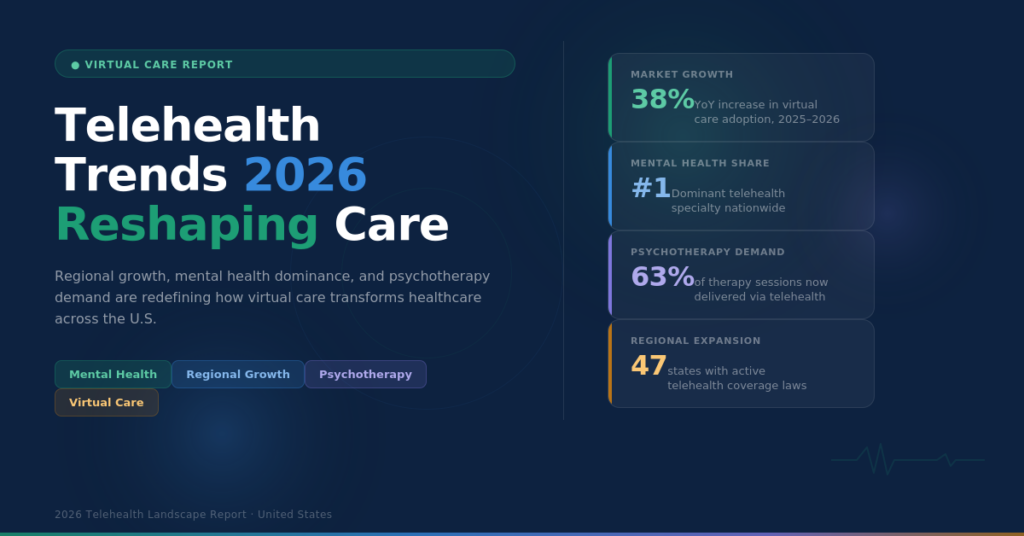
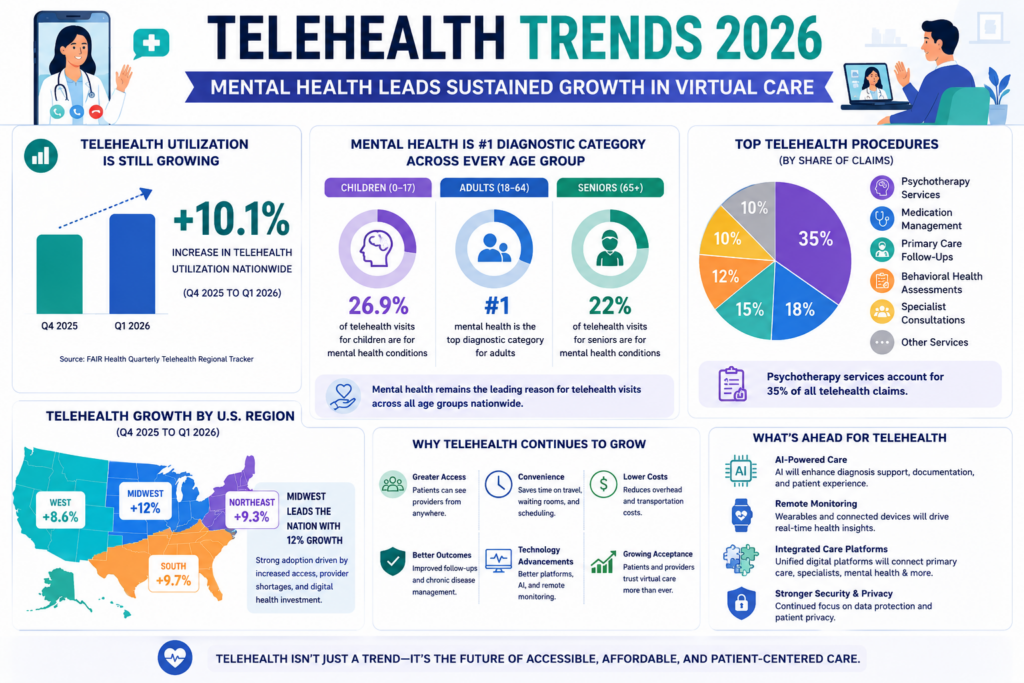
Recent findings from the FAIR Health Quarterly Telehealth Regional Tracker indicate that telehealth utilization in the United States increased by 10.1% between Q4 2025 and Q1 2026, reversing the assumption that virtual care usage would plateau. Even more significant is what patients are using telehealth for: mental health conditions remain the number one diagnostic category across every age group, from children to older adults.
This trend highlights a broader transformation in healthcare. Patients increasingly value the convenience, accessibility, and flexibility of virtual consultations, while providers continue expanding digital services to meet growing demand.
After reviewing the latest industry reports, healthcare data, and regional adoption trends, it’s evident that telehealth is no longer simply about replacing office visits—it is becoming a core component of patient care, chronic disease management, and mental health treatment.
Quick Summary
| Category | Key Insight |
| National Growth | +10.1% (Q4 2025 → Q1 2026) |
| Fastest Growing Region | Midwest (+12%) |
| Top Telehealth Service | Psychotherapy (35% of claims) |
| #1 Diagnostic Category | Mental Health |
| Children Using Telehealth | 26.9% Mental Health Visits |
| Seniors Using Telehealth | 22% Mental Health Visits |
Why Telehealth Continues to Grow
Telehealth is no longer viewed as a temporary alternative to traditional healthcare.
Instead, it has become an essential healthcare delivery model.
Several long-term trends continue to drive adoption:
- Greater acceptance among patients
- Increased provider investment
- Better reimbursement models
- Improved broadband connectivity
- Growth of remote patient monitoring
- Rising mental health demand
Perhaps the biggest shift is that patients now expect healthcare to be available both in-person and digitally.
Healthcare is becoming hybrid.
Key Findings from the FAIR Health Quarterly Telehealth Regional Tracker
The latest FAIR Health data paints a clear picture of sustained growth.
National Utilization Increased
Telehealth usage increased 10.1% nationally between Q4 2025 and Q1 2026.
This indicates continued adoption even after healthcare systems returned to normal operations.
Mental Health Dominates
Mental health remained the top diagnostic category across every age group.
This is one of the strongest indicators that telehealth has become a preferred channel for behavioral healthcare.
Psychotherapy Leads
Psychotherapy services represented approximately 35% of all telehealth insurance claims, making them the single largest category of virtual care.
Mental Health Is Driving Virtual Care
One of the most interesting findings from recent research is the consistency of mental health demand.
Unlike many medical specialties that returned primarily to in-person appointments, behavioral healthcare continues to thrive online.
Children
Approximately 26.9% of pediatric telehealth claims involved mental health conditions.
Parents increasingly value virtual appointments because they:
- Reduce travel
- Minimize school disruption
- Improve access to specialists
Adults
Working professionals often prefer telehealth because appointments can be scheduled around work hours.
Privacy and convenience also contribute to higher adoption.
Seniors
Perhaps the biggest surprise is among older adults.
Nearly 22% of telehealth visits for seniors involved mental health services.
Historically, this demographic showed lower digital adoption.
Today’s data suggests that comfort with virtual healthcare continues to improve across all age groups.
Regional Telehealth Growth Across the United States
The FAIR Health report also highlights interesting regional differences.
Midwest
The Midwest recorded the strongest growth with approximately 12% quarter-over-quarter growth.
Possible drivers include:
- Expanded rural healthcare access
- Provider shortages
- Greater investment in digital health
Northeast
Continued strong utilization supported by established healthcare systems.
South
Steady growth driven by expanding virtual primary care networks.
West
The West continues leading innovation through:
- Digital health startups
- Remote monitoring
- AI-powered healthcare platforms
Most Common Telehealth Procedures
Virtual care has expanded far beyond routine consultations.
The leading telehealth procedures include:
- Psychotherapy (35%)
Still the largest category.
Virtual therapy has become mainstream.
- Medication Management
Follow-up consultations remain highly suitable for telehealth.
- Primary Care Follow-Ups
Routine chronic disease management increasingly occurs virtually.
- Behavioral Health Assessments
Growing demand continues across all demographics.
- Specialist Consultations
Patients can access specialists without traveling long distances.
Real-World Example: How Telehealth Expanded Mental Health Access
One of the most visible examples of telehealth’s long-term impact comes from the rapid expansion of virtual mental health platforms such as Teladoc Health and Talkspace during and after the COVID-19 pandemic.
Initially, many providers expected virtual therapy demand to decline once clinics fully reopened.
Instead, millions of patients continued using online counseling because it offered:
- Greater scheduling flexibility
- Reduced travel time
- Increased privacy
- Better access to licensed therapists, particularly in underserved areas
Publicly available reports from these providers have consistently highlighted sustained demand for virtual behavioral health services, reinforcing broader industry findings that mental health remains the leading telehealth use case.
Why This Matters
The success of virtual therapy demonstrates that telehealth is not merely replacing in-person appointments.
It is expanding access to healthcare for people who may otherwise delay or avoid treatment due to distance, scheduling challenges, or limited local availability.
Key Lesson
The strongest telehealth growth is occurring in services where convenience, accessibility, and continuity of care matter more than physical examinations.
Mental healthcare fits that model exceptionally well.
Benefits of Telehealth
Better Access
Patients can consult specialists regardless of location.
Reduced Waiting Times
Virtual scheduling often improves appointment availability.
Greater Convenience
Patients avoid:
- Travel
- Parking
- Waiting rooms
Improved Continuity of Care
Regular follow-up appointments become easier.
Lower Healthcare Costs
Both providers and patients may benefit from operational efficiencies.
Challenges That Still Remain
Despite impressive growth, telehealth is not without limitations.
Licensing Regulations
Cross-state practice rules remain complex.
Technology Access
Reliable internet access is still a barrier for some communities.
Physical Examinations
Certain conditions still require in-person assessment.
Privacy and Security
Healthcare organizations must continue strengthening cybersecurity protections.
What These Trends Mean for Patients
Patients can expect:
- More virtual appointment options
- Faster specialist access
- Expanded behavioral healthcare
- Better integration with mobile health apps
- AI-assisted patient support
Virtual care is becoming a standard option rather than a special service.
What Healthcare Providers Should Expect
Healthcare organizations are investing heavily in:
- Remote patient monitoring
- AI-powered triage
- Virtual nursing
- Digital front doors
- Automated appointment management
Telehealth is increasingly integrated into broader digital transformation initiatives.
Future Telehealth Trends Beyond 2026
Several developments are likely to shape the next phase of virtual care.
AI will support clinicians with documentation and decision support.
Remote Monitoring
Wearables will transmit patient data continuously.
Personalized Healthcare
AI will help tailor treatment recommendations.
Integrated Care Platforms
Patients will increasingly access primary care, specialists, pharmacy services, and behavioral health through unified digital platforms.
Expert Perspective
After reviewing multiple healthcare technology reports, one trend stands out above all others:
Telehealth has moved beyond convenience.
It is becoming an essential mechanism for expanding healthcare access, particularly in mental health.
While some medical specialties naturally require physical examinations, behavioral healthcare has demonstrated that virtual care can often deliver outcomes comparable to traditional appointments while improving patient engagement and accessibility.
Organizations investing in digital health today are not simply responding to patient demand—they are preparing for the future of healthcare delivery.
Frequently Asked Questions
What are the biggest telehealth trends in 2026?
Continued growth, increased mental health utilization, AI integration, and expanded virtual care services.
Why is mental health the largest telehealth category?
Virtual therapy offers convenience, privacy, and improved access to licensed professionals.
Which U.S. region experienced the highest telehealth growth?
The Midwest recorded the strongest quarter-over-quarter growth at approximately 12%.
What is the most common telehealth procedure?
Psychotherapy accounts for roughly 35% of telehealth claims.
Is telehealth replacing traditional healthcare?
No. It is complementing in-person care by providing an additional access channel.
Final Verdict
Telehealth trends 2026 confirm that virtual care is no longer a temporary response to extraordinary circumstances—it has become a permanent feature of modern healthcare. Sustained national growth, rising adoption across every age group, and the continued dominance of mental health services demonstrate that patients increasingly value the flexibility and accessibility of digital healthcare.
As healthcare providers integrate AI, remote monitoring, and more sophisticated virtual care platforms, telehealth is poised to become even more personalized and efficient. The organizations that invest in secure, patient-centered digital health experiences today will be best positioned to meet the evolving expectations of tomorrow’s healthcare consumers.